Can Turo Hosts Use GPS Trackers? Turo's Rules and the State Laws That Apply
Turo lets hosts track their cars but bans AirTags. Three states have rental-car GPS laws, and at least 18 make unconsented tracking a crime. This guide covers which of those rules reach a Turo host, read from the statutes themselves.

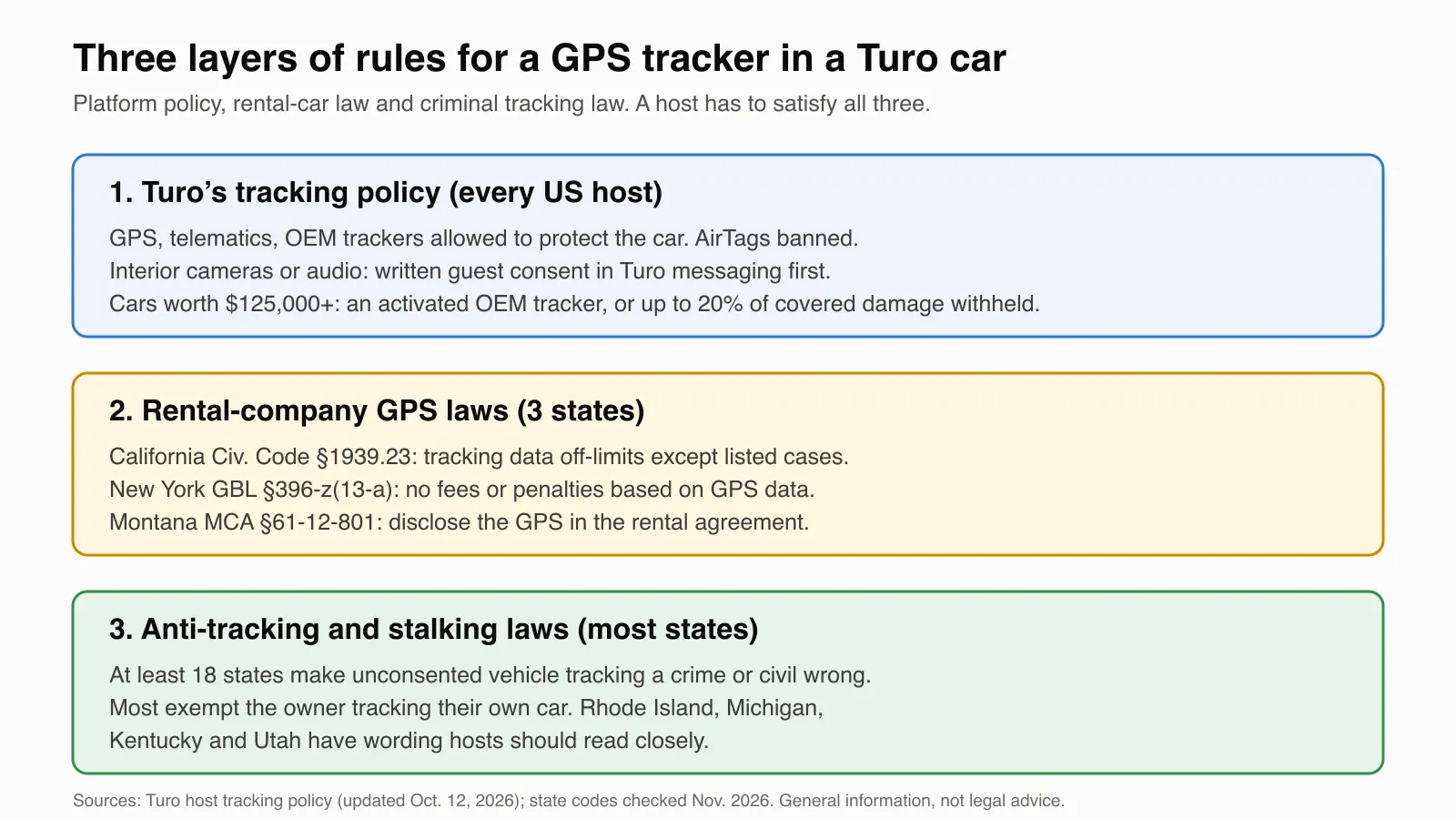
The Turo GPS tracker rules for hosts are short. GPS units, telematics, factory systems and cameras are allowed "to track and protect" a host's car. AirTags are banned, with penalties up to account suspension. A camera that sees the cabin, or a device that records audio, can only be switched on after the guest agrees in writing in Turo messaging. And in the US, a car worth $125,000 or more must carry an activated factory (OEM) tracker. Without one, Turo may withhold up to 20% of covered damages above the plan's damage responsibility.
That is the platform's policy. It isn't the law. Turo's own help page notes that hosts "are subject to additional policy requirements specific to their location". It doesn't list them, and the legal layer underneath is more interesting than most hosts realize. Three states regulate how rental companies may use GPS data. At least 18 make tracking a vehicle without consent a crime or a civil wrong. Whether any of them apply to a Turo host depends on two questions most guides never ask: is a host a "rental company", and whose consent counts when someone else is driving?
The statutes answer both. Everything below links to the official code text, checked in November 2026. It's general information, not legal advice.
What Turo's policy allows, and what it doesn't say
The host tracking policy, last updated October 12, 2026, covers four things:
- Allowed devices: GPS, aftermarket trackers, OEM systems, cameras and telematics devices, used to track and protect the vehicle.
- The one disclosure every host owes: written guest consent, through Turo messaging, before turning on anything that records the interior or records audio. That includes factory cabin cameras and aftermarket dashcams.
- Turo's own uses of device data: recovering a car that is missing or wasn't returned; ending a trip early, suspending a guest or reducing their protection after a report of reckless driving; and sharing camera and telematics data with insurers and law enforcement.
- AirTags: banned as an active tracking device. Turo calls them unreliable and says they "may create a negative guest experience".
The guest-facing version tells renters that a car "may include a tracking device for the purpose of preventing theft". Turo's terms of service add that guests authorize the use of vehicle data "unless prohibited by law."
Two gaps matter. First, US hosts aren't required to mention a GPS tracker in the listing; disclosure is required only for interior cameras and audio. Second, nothing in the policy addresses remote immobilizers ("kill switches"). The terms say only that a host whose car has "disabling technology" must comply with the tracking policy "and applicable law." A host who wants to cut the starter on an overdue car is relying on state law, not on Turo's permission.
The three states with rental-car GPS laws
Most states regulate rental companies' fees, insurance sales and damage waivers. Only three we found say anything specific about GPS.
California: the strictest rule in the country
Civil Code §1939.23 bars a rental company from using, accessing or obtaining "any information relating to the renter's use of the rental vehicle" that came from electronic surveillance technology. The definition in §1939.01 explicitly includes GPS, telematics and other location-based technology. The section was last amended by AB 1197, in force January 1, 2026. It also bans using that technology to track a renter "in order to impose fines or surcharges."
The exceptions are narrow and procedural:
- A missing, stolen or abandoned car, once the renter or police report it.
- An overdue car: either 24 hours late, with 24 hours' advance notice and an advisement the renter initialed in the agreement, or one week late with no notice.
- An AMBER Alert involving the vehicle, or a subpoena or search warrant.
- Geofences that detect a car leaving the country against the agreement, or entering a tow yard.
- Navigation, remote lock and unlock, and roadside assistance at the renter's request. The data may be used only for that function.
- Departure and return times, mileage and fuel level.
Every activation for a missing or overdue car must be logged and the record kept for at least 12 months. Renters can sue under §1939.25, and the winner collects attorney's fees.
New York: track if you like, but don't bill from it
General Business Law §396-z(13-a) is shorter. A rental vehicle company "shall not use information from any global positioning system technology to determine or impose any costs, fees, charges, or penalties" on a driver. The one exception is the cost of recovering a car that is lost, misplaced or stolen. Tracking itself isn't restricted. Speeding fees, out-of-state surcharges and mileage fees computed from GPS data are.
Montana: tell the renter
MCA §61-12-801 requires a rental vehicle business to disclose "the presence and purpose" of any GPS in the rental agreement or a written addendum. No disclosure is needed if the system is used only to track lost or stolen cars or for navigation.
Do these laws reach a Turo host?
Mostly no, with one open question.
New York: its peer-to-peer car sharing act (General Business Law Article 40) keeps program administrators and shared vehicles separate from rental businesses. It has its own data rule as well. §907 says trip data, images and video collected by a car-sharing program are for that program's exclusive use and can't be sold or shared except in listed cases.
Other P2P states: most have the same kind of separation. Washington says a peer-to-peer car sharing program, and a shared vehicle owner, is not a "rental car company". Maryland says a program may not be considered a rental vehicle company. Virginia's act goes further and gives the platform "sole responsibility" for any GPS equipment installed to monitor or facilitate peer-to-peer sharing. That reads as covering the platform's own equipment rather than a host's anti-theft tracker.
California is the open question. Its statute defines a rental company as anyone "in the business of renting passenger vehicles to the public." It defines "personal vehicle sharing programs" separately, but uses that definition only for airport permits and sales tax. Nothing in the chapter says a host is, or is not, a rental company, and we found no case deciding it. A one-car host lending a commuter car on weekends seems an unlikely target. A host running twelve cars as a business looks more like the statute's definition. A California host with a fleet is safest treating §1939.23 as if it applies: use location data only for the listed purposes, log every activation, and don't bill from GPS data.
Montana has no peer-to-peer act, and its definition of a rental vehicle business is broad. Disclosing the tracker in your trip rules costs nothing there.
For a state-by-state view of which places have peer-to-peer acts at all, see our guide to peer-to-peer car sharing laws by state.
Anti-tracking crimes: does the owner's consent cover the renter?
This is where most of the "is it legal?" worry comes from. Over the past decade, and again after AirTag stalking cases made headlines, states passed laws against secretly tracking people and vehicles. They're written to protect people from stalkers, not to stop owners from finding their own cars. But they aren't all written the same way, and a host lends the car to strangers, which is exactly the situation the wording has to handle.
We checked 18 of these statutes against official state sources. We read 16 in full; for Ohio and North Carolina, whose sites blocked automated access, we confirmed the official wording through excerpts. They fall into a few patterns.
| State | Statute | How the owner is treated | Note for hosts |
|---|---|---|---|
| California | Penal Code §637.7 | Exempt if the registered owner, lessor or lessee consents | Driver's consent not required |
| Delaware | 11 Del. C. §1335(a)(8) | Owner, lessor or lessee consent is enough | Covers installation only |
| Illinois | 720 ILCS 5/21-2.5 | Owner, lessor or lessee consent is enough | Owner's consent "constitutes consent for any other driver" |
| Minnesota | §626A.35 | Owner's consent is enough | Only the owner's consent matters |
| Hawaii | HRS §803-42 | Lawful if installed by or with consent of the owner | Felony otherwise |
| Louisiana | R.S. 14:323 | Owner exempt, "including the owner of a vehicle available for rent" | Exceptions lost under a protective order (2025) |
| Oregon | ORS 163.715 | Owner's consent is the test | Covers affixing the device |
| Texas | Penal Code §16.06 | Applies only to a car "owned or leased by another person" | Untested whether a renter is a "lessee" |
| Wisconsin | §940.315 | Applies only to another person's vehicle | Business-owner exception too |
| New Hampshire | RSA 644-A | Applies only to "property of another" | Civil liability only for private parties |
| Florida | §934.425 | Express owner/lessee exception | Remove the device before selling the car |
| Ohio | R.C. 2903.216 | Express owner/lessee exception | Modeled on Florida (2025) |
| Utah | §76-12-305 | Rental companies exempt under a rental agreement | Owner-lends exception excludes leases |
| Virginia | §18.2-60.5 | "Fleet vehicles" (incl. rental) exempt | Crime requires deceptive means |
| North Carolina | G.S. 14-196.3 | Owner exempt; rental "fleet vehicles" exempt | Not under a protective order |
| Michigan | MCL 750.539l | Owner's consent is enough (not leased) | Leased car: lessee's consent and written notice |
| Kentucky | KRS 508.152 | Owner's consent is enough (not leased) | Same lessor notice rule as Michigan |
| Rhode Island | §11-69-1 | No general owner exception | Needs operator's consent; rental entities exempt |
The states that deserve a closer look
Rhode Island is the outlier. Its law turns on the consent of "the operator and all occupants of the vehicle," not the owner. It exempts "entities that rent motor vehicles," but a private person who lends their own car isn't covered by that exception. An individual Turo host may or may not count as such an entity, and no case says which. Getting the guest's written acknowledgment before the trip removes the question.
Michigan and Kentucky treat leased vehicles differently from owned ones. For a leased car, the lessee's or authorized operator's consent is what counts. A lessor who adds an aftermarket tracker must give the lessee written notice that the lessee signs. Neither statute says whether a two-day car-sharing trip is a "lease." The cautious reading is to put the notice in writing.
Utah renumbered its law in 2025 and amended it again with effect from September 1, 2026. The current text explicitly exempts "a rental company" tracking its own car under a rental agreement. Its separate exception for owners who lend their car to someone excludes cars provided "under a lease agreement." A host who isn't clearly a rental company falls between those two exceptions, so written notice is again the simple fix.
Protective orders override the owner exception in Louisiana (since 2025) and North Carolina. That's aimed at domestic abuse cases and is unlikely to touch a host, but it shows the direction these laws are moving.
Stalking laws apply everywhere
Every state, plus D.C., has a stalking or harassment statute, and many name GPS tracking as one way to commit the offense. NCSL keeps a list of these laws. They require a course of conduct aimed at a person, usually with intent to harass or frighten. Tracking your car to recover it isn't that. Using the same data to follow a guest, show up where they are, or keep tabs on them after a dispute could be. The tracker is legal; what you do with the location data is what these laws are about.
A tracking policy that holds up in every state
Put the layers together and a sensible host policy writes itself. It mostly copies California's rules, because they're the strictest:
- Say it up front. Mention the tracker in your listing description or trip rules, even though Turo doesn't require it for US hosts. It satisfies Montana, removes Rhode Island's consent question, and covers the notice rules in Michigan, Kentucky and Utah.
- Use location data for the car, not the driver. Recovery of a missing or overdue car, theft, tow-yard and border geofences, mileage and fuel. Those are the uses California permits, and they're the uses Turo itself lists.
- Don't bill from GPS data. New York bans it outright and California bans fines and surcharges based on tracking. If a guest speeds or leaves the area, report it to Turo through its process instead of inventing a fee.
- Never record the cabin or audio without written consent in Turo messaging. This is the one disclosure Turo enforces against every host.
- No AirTags. Turo bans them, and they're unreliable as trackers anyway.
- Be very careful with kill switches. No Turo rule permits them, and disabling a car that someone may be driving is a safety and liability problem no tracking statute addresses. Nevada's law on starter-interrupt devices covers only creditors and leases longer than 31 days, so it doesn't settle the question for short trips either. Talk to a lawyer before using one.
- Log activations and keep the records. California requires 12 months for rental companies. A log of when and why you looked at a car's location is the best evidence you were protecting property, not watching a person.
Where Fleetiqo fits
We sell GPS hardware, so read this section knowing that. Fleetiqo's GPS devices are OBD-port and hardwired trackers. They feed a live map, geofences with entry and exit alerts, speed alerts, route history and trip replay in the same dashboard that syncs your Turo trips. Hardware is sold separately from the subscription. For the reasons above, we'd suggest using the geofence and recovery features freely, and treating speed alerts as a reason to contact the guest or file a report with Turo, not as grounds for a fee. In New York, a GPS-based fee is exactly what the statute forbids.
How we researched this
We read Turo's US host and guest tracking policies and its terms of service on November 5, 2026. We then checked state codes on official legislature websites:
- Rental-company GPS statutes: the rental-car chapters of California, New York, Montana, Connecticut and 14 other states.
- Peer-to-peer car sharing acts: their definitions, to see whether hosts count as rental companies.
- Anti-tracking statutes: 18 in all. We read 16 in full text, and Ohio and North Carolina through excerpts of their official texts because those sites blocked automated access.
Some points remain open:
- Indiana, Tennessee and Georgia also have vehicle-tracking statutes, but we couldn't read the current official text, so they're left out of the table. Tennessee's law reportedly requires a lessor to get the lessee's consent, which would matter for hosts there if confirmed.
- Connecticut has no rental GPS statute; its well-known GPS speeding-fee dispute was decided under its general unfair trade practices law.
- No court has decided whether California's or Montana's rental-company rules reach peer-to-peer hosts.
Laws in this area change often, especially since the AirTag cases. If you find a statute we missed or one that has changed, tell us and we'll update this page.
Sources
- Turo Help Center, Vehicle tracking and technology policy | Hosts (updated Oct. 12, 2026) (2026-10)
- Turo Help Center, Vehicle tracking and technology policy | Guests (2026-04)
- Turo, Terms of service (revised Oct. 27, 2026) (2026-10)
- California Legislature, Civil Code §1939.23 (rental companies: electronic surveillance technology) (2026-11)
- California Legislature, Civil Code §1939.01 (definitions) (2026-11)
- California Legislature, Penal Code §637.7 (electronic tracking devices) (2026-11)
- New York State Senate, General Business Law §396-z (rental vehicles) (2026-11)
- New York State Senate, General Business Law §907 (peer-to-peer car sharing data) (2026-11)
- Montana Legislature, MCA §61-12-801 (rental vehicle GPS disclosure) (2026-11)
- Virginia General Assembly, Code of Virginia §46.2-1417 (P2P platform responsibility for equipment) (2026-11)
- Virginia General Assembly, Code of Virginia §18.2-60.5 (unauthorized use of electronic tracking device) (2026-11)
- Washington State Legislature, RCW 46.74A.010 (peer-to-peer car sharing definitions) (2026-11)
- Maryland General Assembly, Insurance Article §19-520 (peer-to-peer car sharing) (2026-11)
- Texas Legislature, Penal Code §16.06 (unlawful installation of tracking device) (2026-11)
- Florida Legislature, Fla. Stat. §934.425 (installation or use of tracking devices) (2026-11)
- Illinois General Assembly, 720 ILCS 5/21-2.5 (electronic tracking devices) (2026-11)
- Minnesota Legislature, Minn. Stat. §626A.35 (mobile tracking devices) (2026-11)
- Michigan Legislature, MCL 750.539l (tracking devices) (2026-11)
- Kentucky General Assembly, KRS 508.152 (unlawful use of a tracking device) (2026-11)
- Wisconsin State Legislature, Wis. Stat. §940.315 (global positioning devices) (2026-11)
- Delaware General Assembly, 11 Del. C. §1335 (violation of privacy) (2026-11)
- Louisiana State Legislature, La. R.S. 14:323 (tracking of a person) (2026-11)
- Rhode Island General Assembly, R.I. Gen. Laws §11-69-1 (unauthorized tracking devices) (2026-11)
- Oregon Legislature, ORS 163.715 (unlawful use of a GPS device) (2026-11)
- Utah Legislature, Utah Code §76-12-305 (unlawful tracking) (2026-11)
- Hawaii State Legislature, HRS §803-42 (interception and tracking devices) (2026-11)
- New Hampshire General Court, RSA 644-A (electronic tracking devices) (2026-11)
- Ohio Legislature, Ohio Rev. Code §2903.216 (tracking devices) (2026-11)
- North Carolina General Assembly, G.S. 14-196.3 (cyberstalking, electronic tracking) (2026-11)
- National Conference of State Legislatures, Private Use of Location Tracking Devices: State Statutes (2025-12)
The monthly Turo-host playbook
One email a month: what changed on the platforms, what other operators are doing about it, and the occasional thing we learned the hard way. No sequences, no upsells.
Fleet and Turo-host tips, about once a month. No spam, unsubscribe anytime — see our privacy policy.

