How Turo Hosts Are Taxed: Schedule C, the 7-Day Rule and the 1099-K Gap
Turo income doesn't go on Schedule E, whatever half the internet says. This guide covers where it does go, why your 1099-K is bigger than your payouts, the 7-day rule that decides whether you can deduct losses, and the 2026 depreciation caps and mileage rates, all from IRS primary sources.
Published on

Search "Turo taxes" and you'll find plenty of confident advice that a hands-off host can report their car income on Schedule E, the form landlords use. The IRS's own instructions for Schedule E say the opposite, in one sentence near the top: "Do not use Schedule E to report income and expenses from the rental of personal property, such as equipment or vehicles."
A car is personal property. So the real question in Turo host taxes was never C versus E. It's how the IRS sees your hosting, and that decides three things: whether you owe self-employment tax, whether a loss can offset your salary, and how much of the car you can write off in year one. Most of the money in a host's tax bill sits in those three questions. Few guides answer them from the rules themselves.
This guide covers federal income tax for an individual US host for the 2025 returns being filed now and the 2026 tax year. Everything below comes from IRS instructions, regulations and Turo's own tax pages, all linked. It's general information, not advice for your return. A good preparer is still worth the fee, and you'll get more out of them if you show up knowing this.
Where Turo income actually goes on your return
There are three possible homes for Turo income, and the IRS gives you the test for choosing between them.
Schedule C, if hosting is a business. The Schedule E instructions define the line: if your primary purpose is income or profit, and you rent with continuity and regularity, you're in the business of renting personal property, and it goes on Schedule C. A host who keeps a car listed year-round, answers messages, does handoffs, cleans between trips and takes bookings every month meets that test easily. That covers most hosts reading this.
Schedule 1, lines 8l and 24b, if it's for profit but not a business. Someone who lists their own car for a few weekends a year to cover the payment may be renting for profit without doing it regularly enough to be a business. That income goes on Schedule 1, line 8l ("income from the rental of personal property"), and the related expenses go on line 24b. They're deducted above the line, so you don't need to itemize. The big difference is that there's no self-employment tax.
Not for profit, if there's no real profit motive. The income is still taxable. The expenses generally aren't deductible. If you want the deductions, run the car like something meant to make money, and keep the records that prove it.
| Treatment | Schedule C (business) | Schedule 1, lines 8l/24b | Not for profit |
|---|---|---|---|
| Who it fits | Regular, continuous hosting for profit | Occasional for-profit rentals | No real profit motive |
| Income taxed? | Yes | Yes | Yes |
| Expenses deductible? | Yes | Yes | Generally no |
| Self-employment tax (15.3%) | Yes, if net earnings are $400 or more | No | No |
| QBI deduction | May apply | No | No |
A single-member LLC doesn't change any of this unless it has elected to be taxed as a corporation. By default the IRS disregards it, and the income lands on your own Schedule C.
Why the Schedule E myth keeps circulating
Two things get mixed up. Schedule E is where real estate rentals go, and real estate rentals are usually passive. Hosts hear that a hands-off Turo setup might be "passive", and conclude it belongs on the passive-income form. But passivity is a separate test that applies on whichever form you use, including Schedule C. The Schedule C instructions say so: rental activities are generally passive, with exceptions listed in the Form 8582 instructions. Which brings us to the rule that matters more than the form.
The 7-day rule: why most Turo hosting isn't a "rental activity"
Under the passive activity rules, a "rental activity" is passive by default, whether you put in 5 hours or 500. That would be bad news for a host with a loss to deduct, except for an exception that fits short-term car rental almost perfectly.
Treasury Regulation §1.469-1T(e)(3)(ii) says an activity is not a rental activity if the average period of customer use is seven days or less. It also isn't one if that average is 30 days or less and you provide significant personal services. The Form 8582 instructions repeat both exceptions.
The "average period of customer use" has a precise definition in §1.469-1(e)(3)(iii). For each class of property, you add up the days in every rental period that ended during the year and divide by the number of periods. If you group your cars into classes with very different daily rates, each class's average is weighted by its share of gross rental income. For a host whose cars are all priced similarly, it comes down to total rental days divided by number of trips.
Take a host with 40 three-day weekend trips and 4 thirty-day monthly rentals in a year. That's 120 + 120 = 240 rental days over 44 trips, an average of about 5.5 days. They're under the line. Double the monthly rentals and keep the weekends, and it's 360 days over 48 trips: 7.5 days. Now it is a rental activity, and for a non-real-estate rental, material participation no longer rescues it. The $25,000 allowance that helps small landlords applies only to rental real estate, so it doesn't help here either.
This is worth knowing before you chase Turo's monthly-rental demand. Long bookings can be good business. But if the fleet runs at a tax loss (common in a year with large depreciation), a shift in average trip length can turn a deductible loss into a suspended passive loss you can only use against future passive income.
If you're under 7 days, material participation decides
Once hosting falls outside the "rental activity" definition, it's treated like any other business. A loss is non-passive if you materially participate under any one of seven tests in the Form 8582 instructions. The three most relevant to hosts:
- More than 500 hours in the activity during the year.
- More than 100 hours, and not less than any other individual.
- Your participation was substantially all of the participation of everyone involved.
The second test is the trap for hosts who use a co-host or a cleaning and handoff service. If your co-host logs 300 hours of deliveries and cleaning while you spend 150 hours on pricing, messaging and maintenance, you fail that test even though you clearly work in the business. Keep a time log for any year you expect a loss. A calendar export and message history make better evidence than estimates written in April.
What your 1099-K actually reports
The One, Big, Beautiful Bill restored the old federal threshold for Form 1099-K. Platforms report you when gross payments exceed $20,000 and there are more than 200 transactions, retroactively, as the IRS confirmed in IR-2025-107. The $600 threshold that the IRS kept postponing is gone.
Some states set their own lower floors. Turo's US tax page lists them for 2025: Arkansas ($2,500), the District of Columbia ($600), Illinois ($1,000 and 4 transactions), Maryland ($600), Massachusetts ($600), Montana ($600), New Jersey ($1,000), Vermont ($600) and Virginia ($600). Turo emails the form by January 31 and posts it in the "Tax information" section of the Earnings tab. It won't mail a paper copy unless you ask.
Not getting a 1099-K changes nothing about what you owe. The form is an information return; the income was taxable either way.
The more useful thing to understand is what box 1a contains. Turo explains that it reports unadjusted gross earnings: trip earnings plus Turo's fees, host incentives and host fees. It doesn't include reimbursements or sales tax. In Turo's own words, the figure "will exceed the total amount you received from Turo."
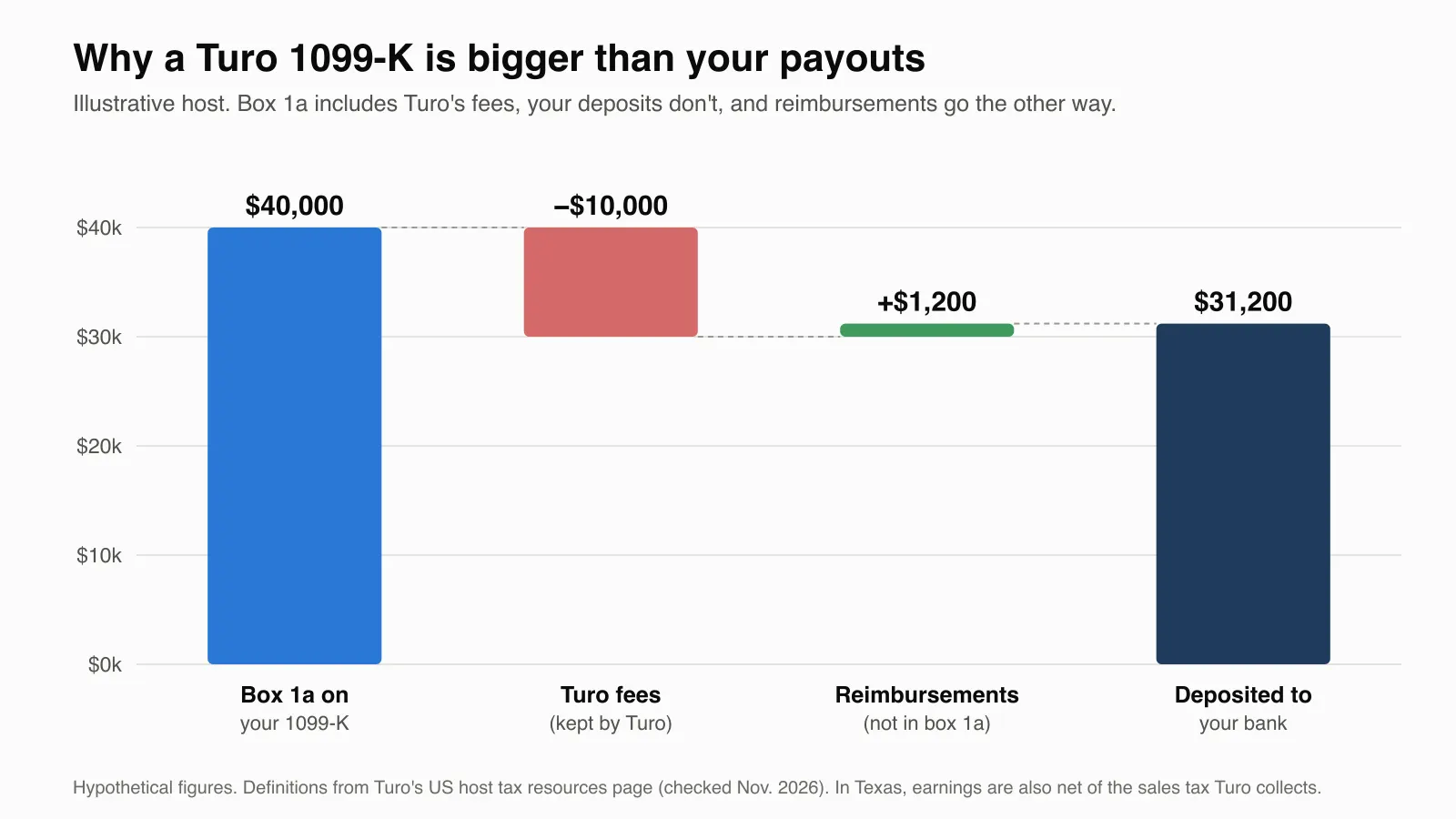
That gap trips up hosts who reconcile from bank deposits. If you report only what landed in your account and the IRS's computer sees a bigger 1099-K, the mismatch invites a notice. The clean approach is to report the full box 1a figure as gross receipts and deduct Turo's fees as an expense. On Schedule C that's line 10, "Commissions and fees." Your net is the same, and the return ties to the form.
Reimbursements, such as a guest paying you back for fuel, tolls or a ticket, sit outside box 1a but still pass through your books. Treat them consistently with the costs they cover, and tell your preparer how they're recorded.
Self-employment tax: the line most new hosts forget
Schedule C profit is subject to self-employment tax at 15.3%: 12.4% Social Security on the first $184,500 of combined wages and self-employment earnings in 2026, plus 2.9% Medicare. You file Schedule SE once net earnings reach $400. You get to deduct the employer-equivalent half in figuring adjusted gross income, but it's still the largest surprise in a first-year host's bill.
Landlords don't pay it because the statute that defines self-employment income, 26 U.S.C. §1402(a)(1), excludes rentals from real estate and from personal property leased with the real estate. A car rented by itself isn't covered by that exclusion. So if you're in the business of renting cars, you owe self-employment tax on the profit.
Two offsets are worth knowing:
- The qualified business income (QBI) deduction under §199A lets eligible Schedule C businesses deduct up to 20% of qualified business income, subject to income-based limits. The 2025 law made it permanent rather than letting it expire after 2025, according to the IRS's explainer on the business provisions.
- Gain on selling a car isn't self-employment income. §1402(a)(3) excludes gains from selling property that isn't inventory. That matters for the depreciation recapture discussed below.
With no withholding on Turo income, you'll generally need to pay estimated tax quarterly if you expect to owe $1,000 or more for the year. Otherwise, raise the withholding on a W-2 job to cover it.
Depreciation: the biggest deduction, and the one that comes back
For most hosts the car itself is the largest cost. Depreciation is how that cost becomes deductible, and 2025 law changed the timing a lot.
Bonus depreciation is back to 100%. Notice 2026-11 confirms a permanent 100% first-year deduction for eligible property acquired after January 19, 2025. Used cars can qualify if you didn't use them before. For the first tax year ending after January 19, 2025, you can elect a 40% rate instead. A car acquired on or before January 19, 2025 stays under the older phase-down rules.
But the luxury-auto caps still bind most cars. For a "passenger automobile", Section 280F limits each year's depreciation regardless of bonus. Rev. Proc. 2026-15 sets these caps for cars placed in service in 2026:
| Year of use | With bonus depreciation | Without bonus depreciation |
|---|---|---|
| 1st year | $20,300 | $12,300 |
| 2nd year | $19,800 | $19,800 |
| 3rd year | $11,900 | $11,900 |
| Each later year | $7,160 | $7,160 |
So a $24,000 sedan used entirely for rental in 2026 can generate up to $20,300 of depreciation in year one, not $24,000. Publication 946 defines a passenger automobile as rated at 6,000 pounds or less: unloaded gross vehicle weight for cars, gross vehicle weight for trucks and vans. Heavier SUVs, vans and pickups fall outside the caps, which explains the popularity of the "6,000-pound SUV" tactic. Let the rental economics pick the car, not the deduction.
Business use has to stay above 50%. If a car's qualified business use drops to 50% or less, you lose bonus and §179 for it. You may also have to recapture excess depreciation from earlier years. Hosts who also drive their Turo car personally should log those miles honestly. The deduction depends on the split.
Then you sell the car. Depreciation lowers your basis, and when you sell, the gain up to the depreciation you claimed is taxed as ordinary income. That's depreciation recapture, under §1245. Say you wrote off $20,300 on a $24,000 car and sell it two years later for $17,000. Most of that sale is taxed as ordinary income. What makes year-one expensing worth it is the timing and the absence of self-employment tax on the gain, not a permanent tax saving. Fleets that turn cars every 18 to 30 months live with this every year and should plan their sales with a preparer.
The business share of interest on a car loan is deductible, but principal payments are not. Your depreciation already covers the cost of the car.
Standard mileage rate vs. actual expenses
A common assumption is that rental hosts can't use the standard mileage rate because the car is "used for hire." That rule was dropped years ago. Publication 463 now says you can elect the standard mileage rate for a car used for hire, such as a taxi, unless another rule bars it. The rules that usually do bar it for hosts are in section 4.05 of Rev. Proc. 2019-46:
- Five or more cars used at the same time. The procedure names this "fleet operations." A host with five cars listed at once can't use the standard rate for any of them.
- The car has already taken MACRS, §179 or bonus depreciation, or any method other than straight line. Bonus depreciation in year one rules out the standard rate for that car permanently.
- You must choose it in the first year the car is used in your business. You can switch to actual expenses later (with straight-line depreciation), but you can't go the other way.
The rate changed mid-year in 2026, which hasn't happened since 2022. It's 72.5 cents per mile for January 1 to June 30 under Notice 2026-10. From July 1 it's 76 cents under Announcement 2026-11, which the IRS attributed to fuel prices. Parking and tolls, interest on the car loan and state and local personal property taxes are deductible on top of the rate.
There's a harder question the rules don't answer cleanly: whether miles driven by renters count as your business miles under the standard rate. Preparers disagree, and the answer can swing a host's deduction by thousands of dollars. Discuss it with your preparer instead of picking the reading that pays more.
In practice, most hosts with newer cars use actual expenses: fuel and charging, insurance, maintenance, repairs, tires, cleaning, registration, Turo fees, software and depreciation. Hosts with one or two older, high-mileage, paid-off cars are the ones most likely to come out ahead with the standard rate, and the first-year rule means that choice must be made deliberately.
Records that survive a question from the IRS
Publication 463 is specific about car records. For each business use you need the date, the destination and the business purpose, plus the mileage, and you need total miles for the year. "Timely" means recorded at or near the time; a weekly log counts. You keep the business-use records for every year of the car's recovery period, not just the usual three.
For a host, a defensible file per car looks like this:
- Every trip, with dates and odometer readings at pickup and return. These are the renter miles that establish business use.
- Your own trips in the car, each classified as business (delivery, the detailer, the shop) or personal.
- Every expense, with a receipt, assigned to a car.
- Purchase documents, financing statements split into interest and principal, and the sale paperwork when the car goes.
- Turo's annual "Tax information" breakdown and your transaction history download, so box 1a can be reconciled line by line.
Full disclosure: this is the problem we built Fleetiqo to solve, so take this paragraph with that in mind. Turo Sync imports your trips, and the dashboard's tax page exports a Schedule C–style summary of what you recorded. That includes totals per line and per car, every expense with the line it maps to, a depreciation working sheet, loan payments split into interest and principal, and a mileage log. The log separates renter miles from your own business and personal miles, and it puts a standard-rate figure only on trips you logged as your own business use, never on renter miles. Two caveats are printed on the export itself, and we repeat them here. It's a summary for your preparer, not a filed-ready return. Its depreciation is book depreciation, not the MACRS, bonus or §179 figure that goes on Form 4562. Your preparer still makes those calls.
State taxes are a separate layer
Everything above is federal. Your state income tax usually starts from the same federal numbers. Rental and sales taxes on trips are their own world. Turo collects sales tax on Texas trips, so Texas hosts' earnings are net of it. In Hawaii, Turo collects the general excise tax and the rental motor vehicle surcharge as a marketplace facilitator, though, as Turo's help center notes, some excise-tax obligations stay with the host. Several other states now charge taxes aimed specifically at peer-to-peer car sharing, including North Carolina's new 8% tax. Our state-by-state guide to peer-to-peer car sharing laws lists each state's rules with citations.
Before you meet your preparer
Bring answers to the questions that change the outcome:
- Is hosting regular and continuous enough to be a business, or occasional?
- What was your average trip length for the year, computed from your trip history? Is it above or below 7 days?
- Roughly how many hours did you spend on the business, and did anyone else (a co-host, a cleaner) spend more?
- For each car: purchase date, price, weight class, business-use percentage, and whether bonus or §179 was taken in an earlier year.
- Does Turo's box 1a reconcile to your records once you add back fees and subtract reimbursements?
- Did you sell or retire a car this year, and for how much?
These are the facts a preparer can't find on a 1099-K, and getting them wrong costs far more than most deductions save.
This article is general information about US federal tax rules as of November 2026. It isn't tax or legal advice. Rules change, and the right treatment depends on your facts, so confirm with a qualified tax professional.
Sources
- Internal Revenue Service, 2025 Instructions for Schedule E (Form 1040) (2025)
- Internal Revenue Service, 2025 Instructions for Schedule C (Form 1040) (2025)
- Internal Revenue Service, 2025 Instructions for Form 8582, Passive Activity Loss Limitations (2025)
- Legal Information Institute, Cornell Law School, 26 CFR § 1.469-1: General rules (average period of customer use) (2026-11)
- Legal Information Institute, Cornell Law School, 26 CFR § 1.469-1T: General rules (temporary), paragraph (e)(3) (2026-11)
- Internal Revenue Service, IR-2025-107: FAQs on Form 1099-K threshold under the One, Big, Beautiful Bill (2025-10)
- Turo, Tax resources for US-based Turo hosts (2026-11)
- Turo Help Center, Receiving a 1099-K (2026-04)
- Turo Help Center, Sales tax | Hosts (2026-04)
- Internal Revenue Service, Self-employment tax (Social Security and Medicare taxes) (2026-11)
- Legal Information Institute, Cornell Law School, 26 U.S. Code § 1402: Definitions (net earnings from self-employment) (2026-11)
- Internal Revenue Service, Understanding the Working Families Tax Cuts: business tax provisions (video text script) (2026)
- Internal Revenue Service, Treasury, IRS issue guidance on the additional first year depreciation deduction (Notice 2026-11) (2026-01)
- Internal Revenue Service, Rev. Proc. 2026-15: 2026 depreciation limitations for passenger automobiles (2026-03)
- Journal of Accountancy, IRS issues higher 2026 depreciation limits for passenger automobiles (2026-03)
- Internal Revenue Service, Publication 946 (2025), How to Depreciate Property (2025)
- Internal Revenue Service, Publication 463 (2025), Travel, Gift, and Car Expenses (2025)
- Internal Revenue Service, Rev. Proc. 2019-46 (Internal Revenue Bulletin 2019-49) (2019-12)
- Internal Revenue Service, IR-2025-128: 2026 business standard mileage rate at 72.5 cents per mile (2025-12)
- Internal Revenue Service, Announcement 2026-11 (Internal Revenue Bulletin 2026-29) (2026-07)
- Internal Revenue Service, Estimated taxes (2026-11)
The monthly Turo-host playbook
One email a month: what changed on the platforms, what other operators are doing about it, and the occasional thing we learned the hard way. No sequences, no upsells.
Fleet and Turo-host tips, about once a month. No spam, unsubscribe anytime — see our privacy policy.

