The Turo Welcome Message Template, Rebuilt for Turo's 2026 Rating Rules
Turo now counts every unrated trip against a host's 5-star and maintenance rates, and the bar keeps rising through April 2027. Here are five copy-ready guest messages, from booking to review, and the rule behind each line.

There's a line in Turo's quality standards that changes what a welcome message is for: "Turo calculates a host's 5-star rate and maintenance rate using all completed trips, whether or not a guest leaves a rating." A guest who loved the car and never rated it counts exactly like a guest who didn't.
That used to be a footnote. It isn't any more. Turo is raising the 5-star rate every host has to keep, in three steps: 65% by September 14, 2026, 67.5% by January 4, 2027 and 70% by April 26, 2027, each measured over 90 days. It's also tightening the maintenance rate each car has to keep over its last 10 trips. Turo's page says hosts who miss a 5-star deadline "will have their accounts removed", and a car that misses the maintenance threshold is blocked from new bookings until a mechanic's inspection is approved.
So the classic Turo welcome message template (a friendly note the night before, then hope for a nice review) is still right, but it undersells the job. Your messages are now one of the few levers you have over the rate Turo uses to decide whether you keep hosting. Below are five templates, one for each point in a trip where a message changes the outcome, and the Turo rule behind each part.
What changed in 2026, in one table
All of this comes from Turo's Quality standards page (last updated October 8, 2026) and the All-Star Host program page.
| Measure | How Turo counts it | Bar to clear |
|---|---|---|
| 5-star rate (to keep hosting) | Share of 5-star trip ratings over the past 90 days, unrated trips included | 65% by Sept 14, 2026, 67.5% by Jan 4, 2027, 70% by Apr 26, 2027 |
| Maintenance rate (per car) | Share of 5-star maintenance ratings over the car's last 10 trips | Above 50% from Sept 14, 2026, above 60% from Jan 4, 2027, next step set by January 2027 |
| All-Star Host 5-star rate | All completed trips over 365 days, unrated included | 85% or more |
| All-Star maintenance and cleanliness | Same 365 days, unrated included | 80% or more each |
Two details in the maintenance rule matter for messaging. First, a trip rated five stars overall with the maintenance box left blank counts as a 5-star maintenance rating. Second, the reverse is harsh: "If a trip's overall rating is below five stars or left unrated, it counts against your maintenance rate, the same as an explicit low maintenance rating would."
Here's what that does on a 10-trip window. Under the January 2027 rule a car needs more than 60%, so seven of its last ten trips have to come back five stars. Four trips that end in silence are enough to restrict the car, even if nothing was wrong with it.
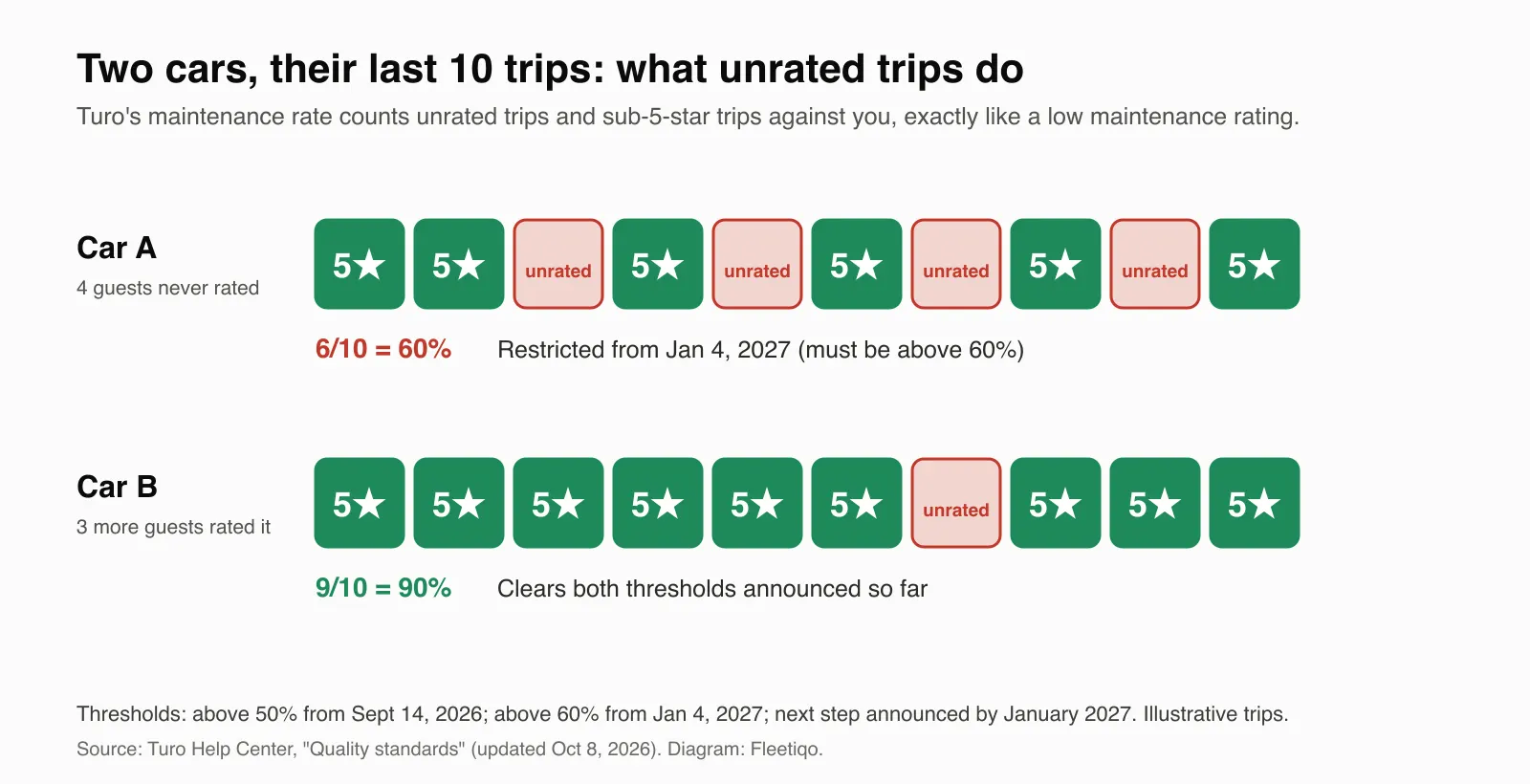
Messages can't fix a car with bald tires. What they can do is stop a guest being surprised (surprises become four-star ratings) and turn some of the silent trips into rated ones.
Set the templates up once
Turo has a built-in scheduler, so none of this needs to be typed by hand each trip. On the website go to Messages, or Inbox in the app, then Manage my scheduled messages and Create new template. Turo's help page describes templates that send "when a guest books, starts, or ends their trip", and the messaging page also mentions check-in time and the run-up to a trip's end. Templates can be switched on and off one by one. The Automations tab lists what's queued for each booked trip, in the trip's time zone, with Send now, Skip or Skip all remaining.
Two practical notes. Turo's help pages don't document a list of fill-in fields for templates, so write the automated versions so they read naturally for any guest on that car, and add personal touches by hand in the thread. And if a scheduled message fails, it shows up with a Try again option, so glance at the Automations tab now and then.
Everything stays inside Turo messaging, on purpose. Turo tells hosts to keep "all communication between you and your guests in Turo messaging so our support agents have a record to settle any disputes." If a claim or a late return ever turns into a dispute, the thread is your evidence.
Message 1: at booking (the expectations message)
Guests can't message you before they book; Turo's guest help page says so in bold, and tells guests whose question isn't answered by the listing to book and cancel if the answer disappoints. That makes the first message after booking the cheapest moment to prevent a bad rating, because the guest can still walk away for free. It also matters more since July 2025, when Turo announced it was removing the free-text vehicle description and guidelines sections from listings, moving FAQs and parking information into the trip details guests see after booking.
Turo's own five-star guide suggests exactly this: a scheduled message at booking that includes "any quirks or must-knows about your vehicle or how it operates." It also advises telling guests in advance about maintenance reminders that aren't urgent. A service reminder that pops up mid-trip without warning reads as neglect. The same reminder mentioned on day zero reads as honesty.
Hi, thanks for booking my [car]. I'm [first name] and I'll be your host.
A few things worth knowing before your trip:
- [Quirk, e.g. "the trunk opens from the button on the key, not the handle."]
- [Anything a guest might mistake for a fault, e.g. "a 'service due' message may appear on the dash. It's a reminder for the next scheduled service, not a problem."]
- [Parking or delivery detail, e.g. "at the airport, the car is in the Economy lot. Parking is paid by me."]
I'll send exact pickup instructions the evening before. If anything here doesn't work for your plans, reply here and we'll sort it out.
Two lines to leave out. Don't ask for payment of anything in this or any message. Turo's gray market policy bans payments outside Turo (Venmo, cash, PayPal, all of it) for deposits, fuel, tolls, delivery, parking and extensions. A violation voids your protection plan for that trip, carries a $150 fee and can lead to removal. The only exception relevant here runs the other way: a host may pay or reimburse a guest in cash for paid parking at a delivery location. And don't promise anything Turo's listing doesn't. "Listing accuracy" is a rating category, and a misrepresentation can fall under Turo's vehicle misrepresentation policy.
Message 2: the evening before (the welcome message)
This is the one most hosts mean by "welcome message," and the original version of this article was built around it. Its job is convenience: the guest should be able to reach the car, open it and drive away without contacting you once.
Evening before beats morning-of. A guest who reads the instructions the night before has time to ask about the one thing that doesn't make sense. A guest who reads them at the curb with a rideshare pulling away does not.
Hi [name], here's everything for tomorrow.
Where: [Exact address or lot, level, row. "Gray RAV4, plate ending 4KD."] Getting in: [Lockbox code and location, key handoff, or app unlock steps.] Before you drive: please add photos of all four sides, the fuel gauge and the odometer to the trip in the Turo app. It protects both of us. Fuel: it's full. Please return it [full / at the same level]. Tolls: [How tolls work on this car.] If you get stuck: message me here. My phone number is also on your trip's Details page if it's urgent.
The car's been cleaned and checked for your trip. Have a great time.
A photo helps more than a paragraph. Turo lets hosts send photos inside the thread and suggests using them "to show guests exactly where to pick up or drop off your vehicle." A picture of the parking spot, or of where the lockbox hangs, ends most "I can't find it" calls before they start.
On phone numbers: Turo shows the host's phone number on the trip's Details page and tells guests to call or text if a host doesn't answer in messaging, so pointing to it isn't a policy problem. Just bring the substance of any call back into the thread afterwards ("as we discussed, you'll return at 6 instead of 5"), so the record exists.
Message 3: day one or two (the check-in)
Turo's guide asks hosts to "check on your guest at least once during the trip to make sure the vehicle is performing well." It's easy to skip because nothing seems wrong. That's the point of it: a guest who mentions a rattle on day one gets a reply; a guest who notices it on day four and isn't asked writes it in the review.
Hi [name], just checking the car's treating you well. If anything feels off, a light, a noise, anything, tell me here and I'll help straight away.
Keep it that short. Its value is in making a minor issue something the guest raises with you instead of with the rating form. If your car has an OBD device or connected-car alerts, this is also when you'd act on one; Turo's guide recommends monitoring on-board diagnostics so you can "reach out to the guest and quickly resolve the situation." (If you use any tracking hardware, our guide to GPS trackers on Turo cars covers Turo's disclosure rules and the state laws.)
Message 4: the day before return (the reminder)
This message prevents the two endings that cost hosts most: a late return, and a "we agreed in chat" extension that Turo doesn't recognise. Turo's position is explicit. Guests can discuss changes in messaging, but "the guest must submit a trip change request via Turo for you to approve. Trip change agreements made in messaging only aren't valid."
Hi [name], a reminder that the trip ends tomorrow at [time] at [return location].
If you'd like more time, please request an extension in the Turo app before then, rather than here in messages, so it's covered properly.
Fuel back to [level], please. On return, take the same photos as at pickup and [lock it / leave the key in the box]. Thanks.
If you charge for fuel, tolls or other incidentals, the gray market page is clear that "the only Turo-approved way to charge a guest for incidental costs is to complete and submit a reimbursement invoice." Mentioning that here in neutral terms ("tolls are billed through Turo after the trip") avoids a surprise charge turning into a sour rating.
Message 5: after drop-off (the review message)
This is the message that the new rules make essential, because it's the one that turns unrated trips into rated ones.
Turo's reviews page gives the mechanics. You have 10 days after a trip to rate the guest. Ratings are published once both sides submit or 10 days after the trip ends, whichever comes first. Turo's own advice is to rate promptly, because "prompt feedback often encourages guests to do the same in return." So do it in that order: review the guest first, then send this.
Thanks for taking care of the car, [name]. I've left you a review.
If you have a minute, a rating helps me a lot. Turo uses it to decide which hosts and cars stay listed. If anything about the trip fell short of five stars, I'd genuinely rather hear it here so I can fix it.
Hope to see you again.
That second line is honest and works better than a generic "please leave a review", because it tells the guest why it matters. The third line gives an unhappy guest somewhere to go besides the rating form. What not to do: don't offer discounts, refunds or anything else in exchange for a rating. Turo's help pages we reviewed don't spell out a review-incentive rule, but an incentive would almost certainly need a payment or a promise outside Turo, and the gray market policy alone makes that a bad trade.
What a message can't do
The templates help most with communication, convenience and listing accuracy. They help less with cleanliness and maintenance, which are about the car. A message saying the car was "checked for your trip" is only worth sending if it was, and Turo's guide gives the checklist: no warning lights, tire pressure and tread checked, a full tank or charged battery, a clean interior with no odors.
Maintenance problems are also the hardest to recover from, because a restricted car can't take new bookings until Turo approves an in-person inspection: a signed report on a shop's letterhead or, in the US and Canada, Turo's form signed by an ASE-certified mechanic. Virtual inspections aren't accepted. When a guest rates maintenance at four stars or less, Turo now asks them to pick the specific issue ("low tire tread," "check engine light," "brakes"). The Reviews tab in the host app shows those by car, and it's worth reading monthly before a pattern turns into a restriction.
The whole sequence, at a glance
| When | Message | Rating it protects | Rule it follows |
|---|---|---|---|
| At booking | Hello, quirks, maintenance reminders, parking | Listing accuracy, maintenance | Turo's five-star guide; guests can cancel early |
| Evening before | Location, access, check-in photos, fuel, tolls | Convenience, communication | Keep everything in Turo messaging |
| Day 1 or 2 | Short check-in | Maintenance, communication | "Check on your guest at least once" |
| Day before return | Return time, extensions via the app, fuel | Convenience | Messaging-only trip changes aren't valid |
| After drop-off | Thanks, why a rating matters | Fewer unrated trips | Unrated trips count against you |
Keeping track across several cars
With one car, the Automations tab is enough. With five, the harder question is which car is drifting: which one has had three quiet trips in a row, or a guest mention of a noise that hasn't been fixed. Fleetiqo's Turo sync reads the booking emails Turo already sends you and keeps every trip per car with its dates, guest and earnings, which makes it easier to line trips up against the ratings in Turo's Reviews tab and your maintenance log. You can see what it covers on the features page.
The welcome message started out as a courtesy. Under Turo's 2026 standards, the five messages above are cheap insurance on the number that decides whether your cars stay listed.
Sources
- Turo Help Center, Quality standards (2026-10)
- Turo Help Center, All-Star Host program (2026-04)
- Turo Help Center, Managing scheduled messages (2026-04)
- Turo Help Center, Messaging your guest (2026-04)
- Turo Help Center, Messaging your host (2026-04)
- Turo Help Center, Guide to a five-star vehicle (2026-09)
- Turo Help Center, Writing and responding to reviews | Hosts (2026-09)
- Turo Help Center, Gray market transaction policy | Hosts (2026-04)
- Turo, New maintenance standards and tools to help you succeed (2026-06)
- Turo, Summer 2025 host release (2025-07)
The monthly Turo-host playbook
One email a month: what changed on the platforms, what other operators are doing about it, and the occasional thing we learned the hard way. No sequences, no upsells.
Fleet and Turo-host tips, about once a month. No spam, unsubscribe anytime — see our privacy policy.


